
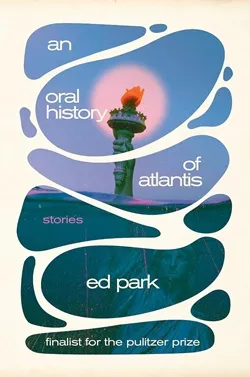
I find this book a bit more challenging to review than other collections of short stories. Ed Park’s An Oral History of Atlantis is interesting in the way he moves past classic short story writing. These are not simple narratives–there are plenty of works here that are clearly influenced heavily by Dada, Surrealism, and other avant-garde forms of literature.
The first story here, “A Note to My Translator,” is one that had me cackling to myself quietly like a loon. I went into it with little in the way of expectations, and–as a reader who hadn’t read anything by Ed Park before–I expected a traditional preface or note of sorts. This was not what I received, and Park’s sense of humor is phenomenal. The attentive reader will find that various names and references make multiple appearances throughout the stories, as is the case of Hans de Krap (the supposed faux-author of “A Note to My Translator”).
“Machine City” plays a bit with concepts from avant-garde cinema (interestingly nested inside a literary narrative), where actors–real people “acting” with their masks in everyday life–play characters in a film being spontaneously recorded. Its plot faintly echoes Synecdoche, New York (and the title–Machine City–seems to point to The Matrix).
“Two Laptops,” for its part, depicts the aftermath of a marriage, and it is echoed some in the following, experimental piece, “Weird Menace.” “Slide to Unlock,” on the other hand, develops its narrative through a protagonist’s choice of computer passwords.
It’s a really odd collection of fiction, and it somehow works. In fact, Ed Park has a powerful way with prose, and his stories, for the most part, land. They are so creative.
One risk of boundary-pushing literature is that it works simply as a curiosity: it’s interesting because it plays with form effectively, or it’s stylistically novel, but it doesn’t have any serious substance to it. Fortunately for readers, that is not the case with Ed Park’s work. He has produced substantive, thematically rich pieces that work as stories while simultaneously doing new things with the written word. That is a remarkable achievement, and I hope other readers will appreciate it as much as I do.
Park’s book isn’t one of my favorites of the year, but I respect it immensely. I suspect that some readers won’t jive with it, but other readers will be enamored. If you look for more traditional forms of storytelling, it might be better to spend time elsewhere, but if you want to explore something new or you like cutting-edge works of fiction, Ed is the man. I suspect that this will be a critics’ favorite for 2025, and it’s easy to see why.