
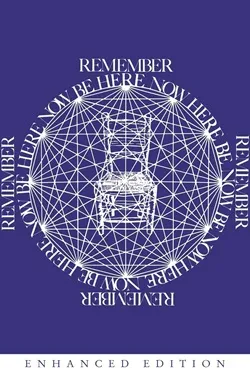
Be Here Now is a better, more hippie version of The Power of Now. The book can be divided into three major sections, with a list of books at the very end.
In the first section, Ram Dass offers an autobiographical account of his struggle with meaning, culminating in the moment when he began to follow his guru somewhere in northern India. The second part is made up of a number of images with handwritten text illustrating Ram Dass’s main points about the unity of all religions, the necessity of existing in the present moment, and recognition that all is One. The final section is a “cookbook” on techniques for meditation, sleep, managing thought and emotion, and numerous other topics.
I think that Ram Dass’s main point is pertinent: there is only the eternal present, and by remembering to be here now we can live more meaningful lives. In addition, his disillusion with academic research is one that I can absolutely relate to (as can, I think Eckhart Tolle, who talks a bit about this in his own books – what is it about us academics finding ourselves on spiritual journeys?). On the other hand, I’m still not entirely convinced about what he says about gurus and chakras. I can see chakras as being symbolically true, but I get the sense that Ram Dass is arguing here that they are literally true. It could be, but my subjective experience hasn’t pointed that way (yet!), and there still is little in the way of “objective,” empirical examination on the topic.
And yet, writing this review puts me in a bind, because I’m engaging in exactly the same trap that Ram Dass cautions against. We can’t rationalize our way through every aspect of our lives. Reason is a powerful tool, but it’s only one tool of many, and at some point we do need to have faith in something. Otherwise, we deconstruct ourselves into the void (which, on the other hand, is also the One!). It appears, then, that there are two pathways there (and this might be how academics wind up there), but we can only see it once we’re ready.
Nothing here is too deep, but Ram Dass’s Be Here Now is a great start. I read it at the suggestion of one friend–a historian of Southeast Asia–who said that it was a great introduction to Buddhism, even if it was written by a white guy from Boston. There wasn’t much here that I didn’t already know, but that’s the funny thing about such traditions: we know all of this already, we just aren’t ready to believe it.