
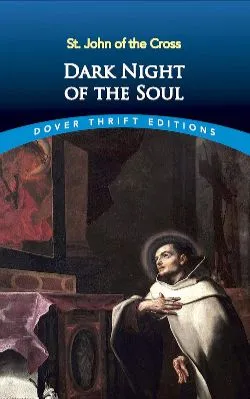
I picked up this book because I believed that I was undergoing the dark night of the soul. Now, funnily enough, I know that I’m not. The expression “dark night of the soul” gets thrown around a lot these days to refer to depressive episodes when there seems to be no light. In former times, we may have called this a good old spiritual crisis. However, the “dark night of the soul,” in St. John of the Cross’s usage, really refers to a period of time on the path of spiritual ascent in a mystical tradition.
Dark Night of the Soul is an interesting work in that it is a commentary on a poem that St. John of the Cross wrote himself. I’ve included the entire text of the poem here:
On a dark night, Kindled in love with yearnings–oh, happy chance!– I went forth without being observed, My house being now at rest.
In darkness and secure, By the secret ladder, disguised–oh, happy chance!– In darkness and in concealment, My house being now at rest
In the happy night, In secret, when none saw me, Nor I beheld aught, Without light or guide, save that which burned in my heart.
This light guided me More surely than the light of noonday To the place where he (well I knew who!) was awaiting me– A place where none appeared.
Oh, night that guided me, Oh, night more lovely than the dawn, Oh, night that joined Beloved with lover, Lover transformed in the Beloved!
Upon my flowery breast, Kept wholly for himself alone, There he stayed sleeping, and I caressed him, And the fanning of the cedars made a breeze.
The breeze blew from the turret As I parted his locks; With his gentle hand he wounded my neck And caused all my senses to be suspended.
I remained, lost in oblivion; My face I reclined on the Beloved. All ceased and I abandoned myself, Leaving my cares forgotten among the lillies.
What the poem really discusses is, through contemplative meditation and prayer, the mystic begins to feel his/herself get closer to God. S/he begins to undergo mystical experiences, which I find fascinating. Many mystics become satisfied with their progress and–counterintuitively–develop a number of vices: a sort of egoism perhaps being the most drastic. However, those who continue on the mystical path eventually reach a point where the spiritual experiences stop, and it feels that God is no longer present. This specific stage of mysticism is what is referred to as the “dark night of the soul.”
St. John of the Cross believes that the “darkness” stems from a period of purgation. In order to experience God in his/her/its full presence, it is necessary to be purified of vices. The dark night is when the most intense purgation takes place, and it’s easy to fall backwards and not ascend spiritually.
What is most important to mystical experiences is the process of “unlearning” or “unknowing.” This is a slow process that allows subject/object distinctions (in the language of Richard H. Jones in An Introduction to the Study of Mysticism) to dissolve, creating a feeling of wholeness with God.
In this way, the “dark night of the soul” is really a positive experience, as painful as it may be in the moment.
I’m not sure that I gained as much from this book as I would if I had explored further before reading it–including experiential exploration. I’ll have to come back to it in the future. It’s a challenging text.