

Spoiler Alert
This content discusses key plot points, resolutions, and major surprises. If you prefer to experience the story first-hand, bookmark this page and return later.
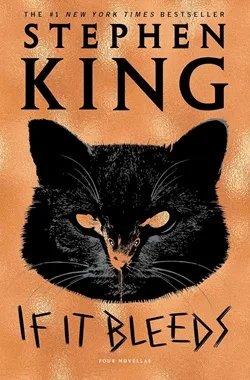
Stephen King’s If It Bleeds, a collection of four novellas (one of which might actually be a novel), is an outstanding collection showing that King is just as strong a writer in the 2020s as he was in the 1970s. While I tend to think of Stephen King as a plot-driven horror/thriller writer, this collection maintains his trademark genres with thematically rich commentary on the nature of evil, Faustian bargains, and the little intimacies that make life worthwhile.
Take, for instance, “Mr. Harrigan’s Phone.” On the surface, it is a ghost story about revenge and ethics: to what extent can we call on other powers without sacrificing ourselves in the process? But, as with most ghost stories, it is a story of trauama and loss. While Mr. Harrigan was hardly loved by his peers, he made a deep connection with the protagonist, and this connection stays with him for a very long time. It is only at the end of the story that he allows himself to properly grieve–shortly after he grieves his beloved teacher.
“The Life of Chuck,” on the other hand, begins with an apocalyptic tale about the end of global society as we know it, only to open up into the rich, inner world of a young man dying too soon. We accompany him as he dances down Boylston Street, sharing an ephemeral moment with street musicians and a young woman experiencing a harsh breakup. It makes all the difference to him, further enriching his world, adding to the multitudes which live inside him. “The Life of Chuck,” too, has its share of ghosts, with an attic that haunts those who visit it. Still, Chuck’s life is one of love and wonder.
The longest story in the collection is “If It Bleeds,” and–while it works as an excellent thriller–King’s development of his ideas on the nature of evil wind up lost. The Changeling, Ondowski, in the story is a vampire of sorts, feeding on people’s suffering (as is almost always the case, vampires are old creatures that corrupt the young). We expect the protagonist, Holly, to lose herself in her hunt for him. But, she doesn’t. She develops strength of will, overcoming her own cowardice and psychological baggage. The story itself is good, and it might be better in recognizing that our expectations are subverted. Even so, some of the themes get lost in the story.
Finally, “Rat” is about a man named Drew who is manic in his desire to complete a novel. Each time he makes headway on one, he loses his ability to find the right words and finds himself collapse into a crisis that his entire family suffers alongside him. When he retreats to the wilderness of northern Maine, he comes down ill, gets stuck in a storm, and neglects his wife, children, and himself. As with previous attempts at writing a novel, he falters until he saves a rat, with whom he makes a Faustian bargain. He completes his story, returns to Maine, reconciles with his family, and publishes his novel to critical acclaim. However, as payment, he loses both his mentor and his mentor’s wife in a freak car crash after he had recovered from pancreatic cancer. The protagonist returns to the cabin in Maine to confront the rat, who taunts him with the knowledge that “[Drew] didn’t finish [the novel]. [Drew] could have never finished it. [The rat] did.” Drew doesn’t seem particularly unnerved by this revelation, and while we readers know never to make a bargain like this, we’re left with the feeling that Drew should suffer more than he actually does.
Some of the stories here flesh out their themes well, others leave the reader wanting better resolution, but all of the stories are well-told in excellent prose. King isn’t a philosopher, he’s a fiction writer and that’s more than enough. The downside, unfortunately, is that I’m left feeling the same way I do after eating fast food: that it tasted good in the moment, but it didn’t provide quite the nutrition I needed.