
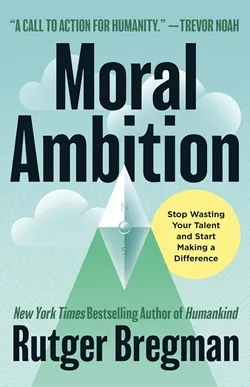
When I picked up Rutger Bregman’s Moral Ambition, I thought that I had picked up a self-help book. Some readers may expect the same thing I did, and it may be read as such, but I think he’s doing something a bit more sophisticated here.
The book starts off as a critique of the way we think about “ambition” today: those with the greatest skills and the strongest drive tend to go into fields like investment banking, management consulting, technology (especially in Silicon Valley), and other financial services. While these industries do have a place, many things produced by these areas can be destructive. In other cases, like management consulting, those within the field often ask what it’s all for and quickly burn out. What does it say about 21st century Western society that the greatest minds are producing algorithms that amplify sophisticated marketing for products that nobody really wants?
On the other hand, there are those who have a strong drive for service. Many with this disposition work in the non-profit industry, where they quickly get swallowed by institions and organizations that–not infrequently–morph into beasts divorced from the problems they are trying to solve. This is especially a shame as there are so many solvable problems in the world today: the only reason they haven’t been solved is because people have not given them the attention they deserve.
As a remedy to those who are ambitious and those who seek out a life of service, Bregman proposes a unifying concept: moral ambition. In defining moral ambition, he points to the story of Thomas Clarkson, an 18th century Englishman who doggedly fought to abolish slavery. He built a coalition, especially with Quakers, who succeeded in their aims. We learn about Arnold Douwes, who pressured the inhabitants of a small Dutch town to take in Jewish people during the Second World War, saving them from perishing during the Holocaust. We also discover Ralph Nader’s narrative, who developed a team of lawyers to fight for small regulatory changes that made an enormous difference: the Traffic Safety Act, the Highway Safety Act, the Clean Air Act, and the Clean Water Act were all passed thanks to Nader’s dogged work.
The idea here is that we can make a difference by using our talents to approach solveable, scalable problems that other people hadn’t thought about before. One example is of an executive who shifted his attention to lowering the high mortality rate caused by malaria. How did he do it? Did he accumulate funds to produce a vaccine, wipe out mosquitoes as such, or improve medical care? No! He mobilized a team to generate funds to buy mosquito nets and distribute them to places where malaria is endemic. Mortality rates, unsurprisingly, fell a tremendous amount. I don’t know about you, dear reader, but I find stories like this to be endlessly inspiring, and they do empower me to make a big difference.
The major issue with the book, in my view, is that it advocates a bit too heavily for “effective altruism.” Effective altruism is a moral philosophy that argues that we should stop focusing on pet projects or things that make us feel good: we should seek out any way possible to help the largest number of people (and animals). On the surface, this makes a lot of sense. It doesn’t matter if people are dying in our community or across the world, we should give our attention to them. There is no disagreement here. My disgreement is with advocates of effective altruism, who tend to emerge out of rationalist circles. They think logically, it’s true, but they attempt to quantify everything and–unfortunately–this is their biggest failing.
It is easy to quantify things like mortality rates, percentages of people without access to shelter, and access to resources. And, given these are fundamental issues of survival, I do agree that they should take precedence over other concerns. But, in my view, well-being beyond basic survival is not something that can be quantified. How do you calculate suffering? How do you calculate joy? How do you calculate community and prosperity and health? We can think about these things in material terms, true, but that simply is not enough. If we want to really make a difference around the world, we have to think beyond metrics.
Take Tunisia, for instance. In numerical terms, it is a middle income country. There is deep poverty, but also a middle class (although it is diminishing due to neoliberal processes). Unemployment is high, but–even so–most people are able to rely on family and community institutions to meet their basic needs. You don’t hear of many people starving or dying of easily-preventable diseases. There is no war displacing people. There is better access to good education in Tunisia than in North America. The crime rate throughout the country is also lower than the United States, and it is lower even than many places in Europe.
Yet, many young people are still trying to leave the country in favor of a better life. Some die at sea as they take rafts across the Mediterranean, attempting to make it to Lampedusa or Pantelleria. Why would they do this if their basic needs are met? Well, their basic needs aren’t met, especially not now. And, more alarmingly, it wasn’t always this way.
Changes in Tunisia, in my view, are less about raw material need (which can be turned into metrics the way that effective altruists do) and more about immaterial needs. Young people need to feel like they’re living meaningful lives. They need to embody a dignified existence. Many think that Europe, for example, might offer this. Some people find it, others are disappointed. While increasing economic investment and providing new opportunities is one way of solving some of these issues, I suspect that it isn’t the core issue. Tunisia was poorer 40-50 years ago than it is today, but few people wanted to leave the country: they felt connected with their country, there was enough–both in material and psychological terms–to live good lives, and they chose to stay. There is nothing that effective altruists can offer that would change circumstances for Tunisian people.
None of this means there aren’t solutions: there are! They just require larger, systemic changes, and I’m hardly qualified to speculate on what many of those specific changes might be.
Bregman, for his part, recognizes some of the limitations of effective altruism, but I don’t think he goes far enough. Effective altruists get a great deal of attention throughout the book, but there are many other ways of approaching “moral ambition” that might have been worth exploring. One risk of the effective altruist pathway is saviorism, which takes agency from those who may be better equipped to solve their own problems. Instead, other useful perspectives might be things like capacity building, investing (whether with time, money, or attention) in those who live the issues that we–on the outside–are trying to solve, and advocacy.
Nevertheless, I found Bregman’s book to be thoroughly inspiring, and he has given me a lot to chew on as I think about what I might be able to offer the world.