
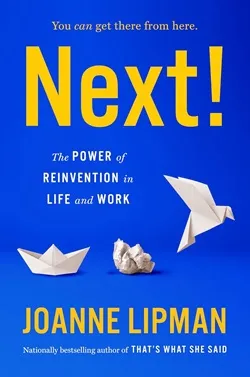
I picked up this book expecting it to be classic self-help and I was pleased to discover that it had little in common with other self-help books. In fact, I would not characterize it as self-help at all: it is the sort of journalism/psychology best done by Malcolm Gladwell.
The author, Joanne Lipman, begins with a simple question: How do people go about reinventing their lives when things aren’t working for them, or they’re simply unhappy? To make sense of this question, she dives into a number of success stories, both major and minor. For example, I had no idea that James Patterson was an advertising executive before he pivoted to writing spy thrillers. I knew nothing about Colonel Sanders, other than that he’s the old guy on the KFC branding. I also didn’t realize that Play-Doh was initially used as a cleaning solution to get soot off of walls when houses were still heated by coal. These are interesting stories, and Lipman mobilizes them well.
In essence, Lipman articulates a four-step process that leads to the most significant reinventions:
- Search
- Struggle
- Stop
- Solution
The model itself reminds me a bit of that old, classic internet meme:
- Step One
- Step Two
- ???
- Profit!
Yet, there is some serious truth to it. In the “search” stage, we try on what Lipman calls “potential selves.” For instance, we might see ourselves as a business executive, a bestselling author, a musician, a programmer. In the “struggle” stage, we fight against whatever problem it is we’re facing. We seek out solutions. In this case, the problem that needs solving is: “How do I want to live the rest of my life?” It’s a big question, and I think it’d be unusual for people to figure this out easily. We’ll apply to jobs, network, do all the things needed to land work or other opportunities, and we’ll find it simply won’t work.
Eventually, we give up. We distract ourselves with other things, pick up new projects, maybe take a long vacation. Often, it is when we “stop” working on the problem that our neurons make their connections and we have a “eureka!” moment. As a result, the “stop” is fundamental to the process of reinvention. And it is only by stopping that we can find big, durable solutions.
Now, not all people follow this exact pathway. Some people inch over their entire lifespan toward goals that they hardly know that they have: it is only upon reaching the finish line that they are able to look backwards and develop a cohesive narrative that clarifies what their goals always really were. Others do have sudden instances of reinvention, taking place in one day, or a week, or some other short period of time. But, these cases are the exception rather than the norm.
Lipman mobilizes a huge number of anecdotes, none of which are half-baked. Some stories come from the world of scientific experimentation and illuminate the ways our brains function, while other narratives follow individuals (or groups) working hard on business innovations.
Even though the book is about a process, it is also useful. It taught me a bit about different pathways I can pursue in my own life, and it gave me validation knowing that I’m not doing anything wrong. There are plenty of models here to look toward, which is so helpful for me.
I’d highly recommend this book to readers looking to make sense of transitions or changes in their own life trajectories. More than anything, Lipman’s book contextualizes what we go through, making the work a bit easier on us.