
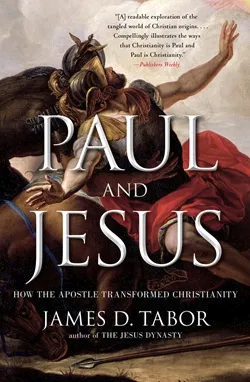
James Tabor’s Paul and Jesus was a book that I found remarkably illuminating. I suspect that there won’t be a great deal here that’s new to Biblical scholars, unless–of course–Tabor is making a fundamentally heterodox argument (which I can’t really assess). However, given his academic post, I suspect that it isn’t the case.
Tabor’s book works on three major levels: it is a deep probe of Pauline Christianity; it is a comparative examination of Pauline Christianity alongside the “Jewish Christianity” governed by James, Peter, and John; and, most interestingly, it is an attempt to excavate early, pre-Pauline Christianity. This is an admirable, although incredibly challenging task. Tabor points out that we, as readers, tend to read the New Testament precisely backwards in terms of chronology. While the four Gospels and the book of Acts claim to be first in the chronological line (in fact, the events taking place in them are first), the truth is that all of the Pauline epistles were written well before the Gospels were. More still, the canonical Gospels–and acts–were heavily influenced by Paul’s followers: he knew Mark personally, and Luke is nothing if not Pauline. So, even when we read the Gospels, we are reading them through the eyes of Paul.
Now, this in itself wouldn’t be a problem, but Paul’s epistemology is suspect, at best. Tabor points out, also rightly, that Jesus never actually knew Paul. Paul converted to Christianity approximately 4-7 years after the death of Jesus, and that Paul pays precious little attention to what the other apostles have to say. On the contrary, he claims that his visions of the spiritual, mystical Jesus are more influential than the lived experiences of the Twelve. Naturally, this put him on a collision course with Jesus’s disciples, and some early Christians went so far as to claim that Paul is a heretic. Yet, Paul’s voice is all that we have, with two major exceptions: “Q” as a source, which Matthew and Luke rely heavily on, and the Epistle of James.
While we don’t have access to an original “Q,” it can be partially reconstructed, and it appears to be a list of Jesus’ sayings (perhaps like the hadith in Islam?). More interesting still, there is little mention here of resurrection, virgin birth, or the idea that Jesus is literally God incarnate. The same is true of James. Given that he was the brother of Jesus, you’d expect him to advocate the position that his sibling is God incarnate. Yet, he doesn’t. What we find, instead, is advocacy for Jesus’ role as the Messiah, as well as a zealous Judaism that the Romans sought to repress.
Most of the practices that we consider so fundamental to Christianity–baptism, communion, and so on–are innovations of Paul. We don’t even have a fully reliable account of the Last Supper, other than to know that one did take place, unless you believe it true that the spirit of Jesus literally convened with Paul and offered him very different guidance from what he gave the other apostles in his lifetime.
I, for one, would not totally rule out the possibility that Paul did see visions, but I am skeptical that they were of the historical Jesus. I’d be much more interested what James, Peter, and John have to say. Yet, with both Peter and John, we’re faced with silence–the documents ostensibly written by them were much more likely to have been written by another, inserting Pauline perspectives. All we have from the original apostles is a brief letter written by James.
Now, there is a lot at stake here. For one, Paul urged Gentiles who converted to Christianity not to become Jewish. The leadership in the Jerusalem church was willing to allow this, but Paul pushed further by arguing that the Torah of Moses–even for Jews–had been wholly superseded by a new covenant produced by the crucifixion of Jesus. For James, Peter, and John, such a case was unacceptable.
Stranger still, and this is something I don’t fully yet understand, Tabor argues that Paul’s vision of Jesus was the creation of a new, spiritual speces of humans. I don’t mean this in a biological sense; I mean that the nature of those “in Christ” was seen by Paul to be fundamentally, qualitatively different than those of other people. I might write Tabor and ask for some further clarification, but this is an interesting point.
Ultimately, Paul won the theological battle. In fact, by ~100 CE, he had totally won. Those convinced by Paul might make a Providential argument; in other words, Paul won because God demand that Paul won. But, if we are a bit more critical, we can see that Paul’s won for social reasons. For one, Gentile Christians quickly outnumbered Jewish Christians, rendering the latter’s opinion moot. Second, the early “Christian” councils in Jerusalem were smashed with the sacking of the Second Temple in 70 CE. Peter and James, like Paul, were killed under the rule of emperor Nero, effectively wiping out the leadership of the first generation of the Christian community. The faction in Jerusalem, as far as I can tell, was much more centralized than Paul’s faction, and the dispersion of Jews throughout the Roman Empire was devestating for their movement.
Altogether, Paul and Jesus is a fascinating, critical examination of early Christianity that might not sit well with churchgoers or those interested in more orthodox interpretations. Still, it is a necessary corrective for the early history of Christianity, and it’s a must-read for those looking for a text that bridges academic and popular analysis.