

Review Transparency
I received a free digital copy of this book from the publisher via NetGalley in exchange for an honest review. My opinions are entirely my own.
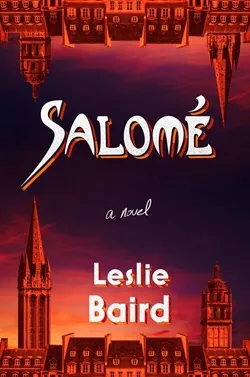
Salomé is a remarkable novel. Upon beginning the book, I was skeptical: I saw the protagonist romanticizing France, and I was concerned that this book would be some escapist fantasy that dealt with love and a sort of Holy Land for young American women. Fortunately, Leslie Baird challenges all of this with tact and grace.
On its surface, Salomé is a reimagining of the Biblical story of Salomé. In short, King Herod felt challenged by John the Baptist’s message, but John was so popular that he refused Herod refused to kill him. However, amazed by the beauty of his stepdaughter’s dancing, he grants her one of anything she wants. Salomé’s mother, Herodias, demands the head of John the Baptist, so Salomé requests it. Herod then offers it to her on a platter. That’s the end of the story.
Now, we have a few of the major pieces in the story here, too: Salomé is, obviously, Salomé. Courtney, our American protagonist, was born on the John the Baptist’s saint day (June 24th), so there’s an immediate identification with him. Moreover, Courtney’s mother is named Elspeth (a clear reference to Elizabeth–both Elizabeth and Elspeth gave birth at an older age, too) Nathalie, Salomé’s mother, then plays the role of Herodias, and Marco maps onto Herod.
However, the narrative quickly diverges, and the story told here isn’t so much a retelling of the John the Baptist/Salomé story as a new act of creation that relies on Biblical characters as a framing.
The novel itself begins with Courtney’s conversation with Salomé on a flight to Paris. The two get along remarkably well, and Salomé invites Courtney to visit her home. Once there, weird things happen–all of the characters have strange nightmares, Salomé’s mother has frequent nervous breakdowns, and there is a general atmosphere of suspicion and uncertainty.
In the process, Courtney’s romantic image of France is shattered. Author Leslie Baird deals deftly with France’s legacy of extreme right politics (especially with regard to the Front National, or whatever they’re called now).
The setting itself is apt: it takes place somewhere near Angers, with scenes in Nantes, Saint-Nazaire, and Paris. Interestingly, Le Mans, also not too far from Angers, is the only place where I’ve seen active attempts to recruit for the Action Française–an extreme-right political league that played an important role between the late 19th century and the Second World War.
Baird also weaves in ethically contentious topics that billionaires–and especially tech barons–are especially interested in: namely, how to live forever. There are also references made to simulation theory, but they aren’t as prominent as the debates over life extension throughout the book. Where Baird diverges from contemporary debates, to her credit, is when she deals with the supernatural. Salomé is certainly a book written to help re-enchant modernity, but Baird does not shy away from the dark underbelly of the supernatural.
Leslie Baird’s characters are almost entirely sympathetic, with one or two major exceptions. Even characters who–on the surface–come off as harsh or cruel are thoughtfully depicted and multidimensional.
Salomé, I suspect, will be a fan favorite, especially in BookTok and Bookstagram circles, but I think that it also deserves much wider attention. It’s a great novel, it manages to balance the scales between plot and characterization, and it’s such a joy to see the characters develop over the course of the novel. I highly recommend it.