
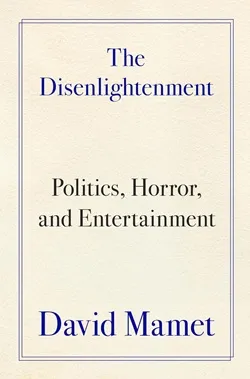
I don’t like to be too critical of books. I can make an exception for David Mamet’s The Disenlightenment.
I picked up this collection of essays because I was interested in the title and subtitle. I had no idea who David Mamet was, nor what he had to say. Having read this book, I know that he is a prominent playwright and screenwriter who generated stories like The Untouchables and even won a Pulitzer Prize. His print writing, on the other hand, leaves a lot to be desired.
Quite frankly, there were sentences in this book where I had little idea what Mamet was trying to say: I had to reread the same sentence multiple times in order to make sense of it. His choice of vocabulary is overly pretentious and doesn’t contribute a great deal to the essays here. At times, it seemed more like he was writing with the aim of impressing others with his intellectual ability, rather than to present ideas with clarity and verve.
Still worse, I find Mamet’s arguments to be nonsensical and out of touch with reality. Throughout the book, he praises Donald Trump for his heroism in saving the American nation, which he contrasts with the legislature. While I do have a tendency to dismiss right-wing politics out of hand, it seems strange that Mamet depicts congressional legislatures as privileging their own interests (which they do) while arguing that Trump is a selfless figure (he is not). There are also some bizarre viewpoints here that I could not understand: in one essay, he depicts ancient Israel as a forerunner of democracy. I’m unsure where this idea comes from; even relying on Biblical evidence, the territory was ruled by judges, unified under a three-king monarchy, split into two monarchies, and was conquered by imperial powers. Admittedly, the Sanhedrin existed, but this was hardly a democratic body: it’d be like arguing the Estates-General in France under the Old Regime was a forerunner of democracy. It was not.
Mamet pulls no punches in accusing other Jewish people, especially those who advocate for Palestine, of anti-Semitic self-hatred. This is a perspective that I find altogether reprehensible. Naturally, there is no need for Jewish people to downplay their background or religious belief, but it is a very different thing to accuse those who fight in favor of justice of being anti-Semitic.
This book is also laced with identity politics. Mamet laments the passing of an age where “men could be men,” trans people were hidden out of sight, and the United States was the prime power in the world. I couldn’t agree with him more, and the fundamental difference is a question of values. I do value difference, complexity, and the variety of human experience, and I think that traditional power structures were just that: power structures.
To use Gen Z slang, Mamet needs to “touch grass” and unplug from various media ecosystems that amplify the worst voices of today. Of course, he can’t do that–he is necessarily plugged into the media world.
To be a bit more charitable, Mamet’s views on storytelling are actually compelling, and he sees the important of story to our lived experience of the 21st century. This is a valuable point worth keeping.
Altogether, while Mamet is famous for his plays and films, his essays are not worth the paper that they are printed on. I do not recommend.