
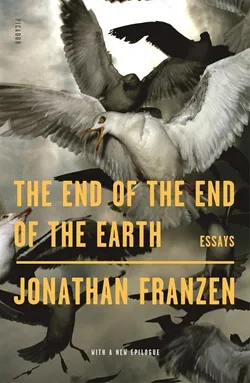
I loved this collection of essays. Jonathan Franzen is one of those names who often comes up, especially in relation to authors like David Foster Wallace (who I also love) and sometimes Zadie Smith (although I’m not sure that Smith personally knows/knew DFW or Franzen), and it’s easy to see why. Although Franzen isn’t a maximalist in the same way that DFW is, he–and the others in the same category–are fighting the good fight in the hunt for authenticity. For Franzen, this comes through best in his ecological writing.
Now, there is a lot in this book about birds. I had no idea that I would learn as much about birds from such a literary icon as I do in this book. The birds of Albania, the birds of Egypt, the birds of Antarctica, the birds of Jamaica, the National Audobon Society: he discusses all of these in the essays found here. But, Franzen doesn’t just talk about birding. For him, it’s not just a checklist. Instead, he sees birding as a way of chasing experiences that he otherwise would not: pushing his way through Serengeti, identifying an Emperor Penguin, adventuring out to see creatures that I’ve never thought about. Such a way of thinking also gives him a thoughtful perspective on the greatest challenge of our times: climate change.
Let me make this clear, Franzen does not–at any point–deny the existence of anthropogenic climate change. What he does deny is the utility of the concept in helping us make real positive change for the planet. For instance, he is critical of the National Audobon Society for its attribution of climate change to the destruction of bird life. “Ok,” Franzen says, “we can point to climate change, but is it a useful concept in this context?” Franzen’s answer is a resounding “no.”
Let me explain: When large organizations blame problems on climate change, people have the tendency to shrug their shoulders and say, “Welp, I guess there’s nothing we can do about this.” Climate change is a big problem, and every person–and species–in the world is a stakeholder. Naturally, some are more responsible than others: those of us in the Global North are the worst offenders (Franzen points out that, under some major frameworks, the average American household exceeds its allotment for energy consumption in two weeks). Even worse, modern industries–whether they be technology, pharmaceuticals, textiles, or anything else–are the greatest polluters. How could we get everyone on board?
Franzen is an advocate, like St. Francis, for working hard to solve the problems that are immediately before you. “Climate change” is not one of these; “natural gas companies abusing Midwestern wetlands” is. One of these framings produces a solveable problem. The other is an apocalyptic vision. Of course, the systemic issues of climate change need to be worked out, too, and I use the passive voice here because I have no idea how it could even begin to be resolved. We are flying past every benchmark and we have likely already launched ourselves beyond some point of no return, but climate grief simply is not helpful. “Climate grief” is comparable to “Leftist melancholia”–it’s about the loss of some aspirational goal. But, rather than wallow in our shame of having “lost,” we need to pull ourselves up and get back to work.
I was particularly impressed by the titular essay, “The End of the End of the Earth,” which plays with words: climate apocalypticism is part of it, but it applies, in this case, to Antarctica, which Franzen visits with his brother. The polar ice caps are melting, and Antarctica might well be called the “End(s) of the Earth.” On the other hand, the essay weaves in a touching story about Franzen’s loss of family members and the grief, love, and sense of connection he felt toward–and that was felt by–his uncle. It’s a beautiful narrative that helps me think about what really matters: connecting with people. Such tangible, material, and earthy feeling stands in stark contrast to the airy writing about abstract, interminable problems like climate change. Franzen, I think, is like me in that he’s pulled between these two poles, and I’m really impressed with the way he navigates them.
I’m so thankful that I was able to dive a bit into Jonathan Franzen’s inner world, if only for a few hours. His writing helped me think differently about familiar problems, and that is–in my view–the surest mark of an incredible essayist. Highly recommend.