
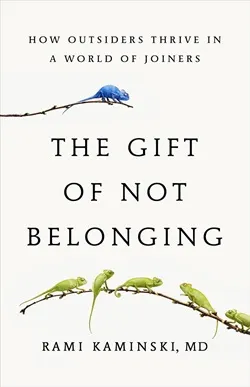
I found this book to be a little bit disappointing. I thought that it would be a book about misfits, and it is, but not in the way we might normally expect.
In The Gift of Not Belonging, author Rami Kaminski pitches his idea for a new category of personality trait? Characteristic? I’m not sure how to describe it.
In essence, Kaminski points out that most people seek belonging in some sort of way. Whether introverts or extraverts, we like to have some sort of group category, and it bothers us when we are somehow excluded from groups. I thought that this experience of being outside the group (often not by choice) would be the center of the novel. But, Kaminski pitches the idea of otroverts, those who do not care about group identity at all. They have little trouble with acceptance; in fact, most of the time, they are likable, respected by their peers, and welcomed with open arms. But, they aren’t interested in joining the larger group, simply because they don’t feel a close sense of identification with it.
The binary then stops being “introvert” and “extravert,” but “otrovert” and “joiner.” The book, then, is about the unique experiences of otroverts and how we can understand ourselves if we are an otrovert, or how we can understand loved ones if we are not.
To his credit, I think that “otrovert” is not a category that fits everyone, which is often the risk when a category is presented in books like this. Reading the text, I determined that I was not one, although the quiz in the appendix tells me that I am. Might this be another way of pushing against group identification? I’m not so sure, but–even when I tell myself that I stand outside and observe–I do act in ways that tell me that I want to be included by others. I also feel rejection when I am excluded by a group that I want to be a part of. So, it isn’t quite clear in my case.
The book is quite surface-level, and I think it’s a reasonable introduction to the concept, but it also requires more substantive psychological research. Kaminski tends to present his arguments more as a clinician than a scientist, which is great for the general reader, but I do question the larger durability of the concept.
Even so, this book may well speak to those trying to find themselves, and it’s a really quick read–it won’t take most readers long to get through at all.