
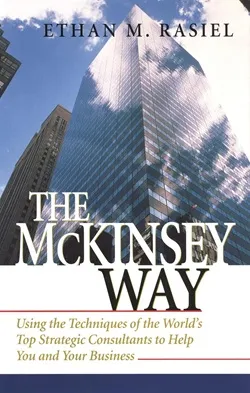
The most striking thing about the “McKinsey Way,” as it is called in this book, is how much of the model described here is a repackaging of social science research methods for private sector organizations. For example, breaking down a problem to its constituent parts is how every single doctoral candidate begins to write their dissertation research proposal. Inidivudal methods include reliance on secondary sources (using McKinsey’s databases), archival research (examining documentation within an organization), interviews (which are widely used), and even ethnography (which offers the same sort of insight as wandering around within an organization). There was remarkably little here that was new to me other than the nature of the questions.
The primary divergence between social science research and the sort of management consulting conducted by McKinsey and other firms is the end result of the research. In theory, at least, a large amount of social science research is a passion project: research for the sake of research, which–perhaps someday–others may eventually use. Other social science research is designed to illuminate problems and potential solutions to make policy recommendations or get a better sense of the society under study. McKinsey’s goal, on the other hand, is almost always financial, and it’s nearly always designed around increasing profit for its clients. Social science research can do this, but it often doesn’t.
This review might give the impression that The McKinsey Way is a comparative study of consulting and social science. It isn’t. But, what you find in here is not limited to McKinsey: there is information on research techniques, how to think about problems, designing presentations, managing non-compliant or even hostile colleagues at the client’s firm, and so on. The end of the book even deals with how to manage life at McKinsey, which seems uniquely grueling (to the extent that more than half of associates depart after two years, although they often find lucrative new positions afterwards). Altogether, author Ethan Raisel’s text is a great introduction to what McKinsey is (and, to be honest, I didn’t fully get what it does until I read this book – now I know that it does what I do, in a different capacity) and how it solves problems.
Still, the book was published in 1999, and it would be nice if there were an updated version that covers insights and developments from the past 25 years. Both business and the nature of technology have changed considerably, and I’m sure that the work at McKinsey has, too, although the core aspects of decision-making outlined here likely still ring true.