
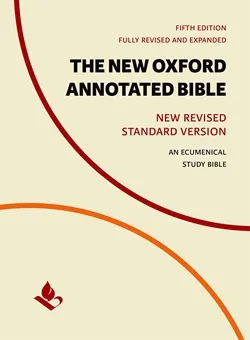
I did it! I can’t believe I finally read through the Bible from cover-to-cover. I picked up this work after having read the Quran during Ramadan. I began reading Genesis in April, and finished Revelation today. I also staggered the general essays at the back of the book as I read the larger text. What I didn’t complete was every word of the annotations and commentary; I tended to read these only when I was curious by what some Biblical author meant by a passage.
The translation here, the New Revised Standard Version, is–I think–the gold standard for those looking for academic approaches to the text. It is neither too literalist nor too figurative, and this version is a benefit in the annotations, which better contextualize and help the reader make sense of different passages. The introductory essays before each book are also an excellent way to wade into questions about composition, interpretation, and structure before jumping into a book. They “prime the pump” and helped me better see what to look for or keep my eyes on.
The major absence here is that this version of the NRSV is the specifically Protestant canon. I also know that the publisher puts out a version of the same text that includes books in Roman Catholic editions, as well as the apocrypha. For those looking for a wider sense of range, it might be worth checking out that version (it has a red cover, whereas the Protestant version has a subdued yellow-y tone).
I’m not qualified to review the actual contents of the Biblical canon; in fact, doing so seems to me that it would be profoundly wrong of me, but I can speak about the structure. The text begins with the “Torah” (the five initial books of the Bible: Genesis, Exodus, Leviticus, Numbers, and Deuteronomy). Deuteronomy acts as a transitional book, which changes the text into what many scholars have called the Deuteronomical History.
The Deuteronomical History, for me, was a high point of the Bible, because it offers a wide-ranging epic focused around a handful of major characters. In fact, the Saul-David cycle (found in the two books of Samuels) shares the same sort of magisterial structure found in Arthurian legends. I also found myself especially attached to Elijah, who hears God in the wilderness as silence. I quote the entire passage here (1 Kings 19:11-13), simply because of how much I loved it:
He said, “Go out and stand on the mountain before the Lord, for the Lord is about to pass by.” Now there was a great wind, so strong that it was splitting mountains and breaking rocks in pieces before the Lord, but the Lord was not in the wind, and after the wind an earthquake, but the Lord was not in the earthquake, and after the earthquake a fire, but the Lord was not in the fire, and after the fire a sound of sheer silence. When Elijah heard it, he wrapped his face in his mantle and went out and stood at the entrance of the cave.
After the Deuteronomical History is the Chroniclers’ History, an examination of the past that takes place after the end of exile in Babylon and the construction of the Second Temple. Second Temple Judaism, in my reading, is remarkably different from “First Temple” Judaism: it is more priestly, more scribal, and less untamed. While many of the prophets lived during the Second Temple period, their message strikes me as being remarkably different from that which came before. Part of it is, even after the reconstruction of the temple, Israel/Judah was no longer an independent state; it forever remained part of other polities.
That said, Samuel and Kings present to the reader a strong, unified kingdom that fragments into two, but it is also clear enough that even the United Kingdom wasn’t particularly powerful. Philistia, with its capital at Gath, remained strong, and there was little to be done about kingdoms like Edom and Moab. This allowed for religious fluidity (even though Elijah and Elisha were particularly strong in critiquing the “High Places” and–especially–the northern kingdom’s widespread acceptance of Phoenician religious practices).
The contrast between the Deuteronomical History and the Chroniclers’ History is remarkable, and I think it is in contrasting the two stories that allow us to see more clearly what this early history may have looked like–or, at least, how it wanted to remember itself. After all, the Chroniclers’ History is an exercise in excission: David, for instance, is the grandson of a Moabite, but Ezra and Nehemiah enforce a politics of purity. These two worlds are virtually incomparable.
The Hebrew text then becomes collections of Wisdom literature, including Job, Psalms–the largest, and perhaps most central text, in the Old Testament–Proverbs, Ecclesiastes, and Song of Solomon. I love Ecclesiastes perhaps more than any other book in the Old Testament, and all of these texts contain material that we can learn from today.
Finally, the Old Testament concludes with writings by the prophets. These are, by far, the most challenging texts in the entire Bible, and the books of Isaiah and Jeremiah are–in my view–the most central of the two. They take rigorous study, and I’m not sure that I fully get them. In fact, I’m not sure that anybody does. Still, they’re important to the Christian tradition, as much of the Gospels are experiments in reinterpreting them, especially Isaiah and Micah. Of these texts, I–like many–find Daniel to be a curious, fascinating text.
The New Testament begins with the Gospels: four readings of the life of Jesus and his ministry. Three of these–Matthew, Mark, and Luke–have close similarities. They are the “Synoptic Gospels” and all rely on Mark as a primary source. Matthew and Luke also rely on a source that scholars call “Q” while containing their own material. Of the three Synoptic Gospels, Luke’s is the most academic, while Mark’s is striking in that it seems almost unfinished. More than a coherent text, it strikes me as an outline in progress. Matthew and Luke are necessary to gaining a fuller picture.
John, on the other hand, is a fundamentally different sort of text. While it, like the other Gospels, tells the story of Jesus’s life and ministry, culminating in his resurrection, it downplays Jesus’s role as “fisher of men” and highlights his role as the light and the embodiment of the Logos itself. There’s something mystical about John, and I’m not sure how to approach it.
The Book of Acts, likely also written by Luke, is a narrative examination of the spread of the early Christian community (although they did not call themselves that) in the wake of the death of Jesus. Structurally, it is a fascinating text. It begins with Peter and the other apostles in Jerusalem and concludes with Paul–who had previously persecuted Jewish Christians–in the heart of Rome. Between these bookends, the apostles criss-cross the eastern Mediterranean, expand the message to Gentiles, build community institutions, and spread the Christian faith. While Peter seems to be the central character of Acts at the beginning, Paul develops an overwhelming importance, and the book is laden with symbolic weight.
The penultimate section of the New Testament is the Epistles, most of which were letters written by Paul to guide newly-found Christian churches. The message that Paul offers seems less a reflection of Jesus’s teachings in the Gospels and more a development of them. Perhaps this is a controversial argument for the general public, but I would make the case that Christianity–as a religion–begins not with Jesus but with Paul. There is continuity with earlier Jewish traditions in the Gospels, but the Pauline epistles syncretize it with that which is Greek. In the process, Christianity is largely Hellenized, including in places like Syria. Given the numerical weight of believers in the Hellenic Eastern Mediterranean, they come to overshadow “Jewish Christians” who remained in Palestine, and especially in Jerusalem. There are a few other epistles here, largely claimed to be by figures like Peter, John, and James, although it is more likely their disciples who wrote under their names.
Finally, there is the Book of Revelation. I will be up front here: any person who claims to understand this text is probably lying. John of Patmos, its author, claims that he himself required angelic mediation in order to understand his own vision. There are meanings behind meanings. It is a dense, labyrinthine network of signs and symbols that–at first glance–refer to one thing, but might also refer to another? Babylon as Rome (or might it be a different place?), the beast as Nero (or the emperor as a category? or something else entirely?). There are echoes of seven: 7, 7, 7. At the same time, there’s the famous “mark of the beast.” The lamb, ostensibly referring to Jesus, has many eyes. There are four horsemen referring to pestilence and war and famine and more. What does it all mean? It is a text that the most capable Surrealist artist would be proud of, and it is powerful.
I’m sure that it’s mystical, but I won’t even begin to make predictions. That said, I don’t think it’s about the future or about the end times. I also don’t see it as being a historically-situated text referring exclusively to persecutions being experienced by the early Christian community. I see it as something more symbolically universal than that. As to what it means? I can’t say.
The essays at the end of the book are excellent for contextualizing the way the Bible has been interpreted, the geography of the text, and the time periods within. The annotations, as I read, were also excellent, although it would take full commentaries to answer all of my questions (and probably, most are left as debates rather than answers).
This updated edition of the New Revised Standard Version is the gold standard for what a Bible should look like, and I can see myself coming back to consult it in the future.