
Have we lost sight of one of the most important things that guide our lives, the seasons? It is easy to think so. As I write this, the weather outside my house is a cool 40°F (5°C). It certainly isn’t as cold as it gets in the frigid Midwestern winter, but the temperature is low enough that I would suffer if I were out for too long without a good coat and gloves. Moreoever, it is 9:25 pm: awfully late to be writing, given that I don’t have a fire. In fact, my office is lit by artificial electricity and the temperature is kept at room temperature. If it weren’t for the occasional drafts, I’d hardly know–from inside my home–that it is winter at all.
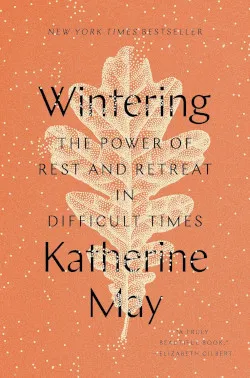
Nevertheless, seasons continue to affect us, Katherine May argues in her hybrid memoir. In fact, we live two types of seasons simultaneously: we live planetary seasons each year, but our lives also go through seasons. May’s memoir charts her experience of her most recent winter–one of many in her life by drawing inspiration from the world outdoors. What can we learn from the way others experience winter? In doing so, May recounts her experiences with Samhain (which inaugurates the winter), saunas, saints, and the solstice. She also plunges into the English channel in February, explores the possibility of homeschooling her son, and even engages with the more-than-human world: her chapter on the way that bees survive the winter is especially interesting. While we normally think of them as hard-workers or fundamental egalitarians, there is a larger lesson here in staying warm given hostile conditions.
May’s winter, like mine, began with a series of health crises. First, her husband came down with appendicitis, and she worried that she may lose him. Then, she herself became ill; she took time off work at the university, ultimately leaving the position in the course of winter. The funny thing about avoiding seasonal cycles is that–whether we like it or not–they will ensure we hear them. In May’s case, it seems to me that she was overcome by an intense case of burnout. Her retreat gave her the chance to slow down and ground herself in the larger world. In doing so, she unloaded the heavy burden she carried and was able to return to her needs, which had for too long been neglected. Modern “life” has a way of impeding the very fundamentals we need to survive: connection, rest, presence, and–perhaps most importantly–a sense of peace.
Wintering was published at the right moment: although it was released in 2020, May had gone through her own winter the year prior, so her book acted as a roadmap for thousands of people who needed guidance navigating increasingly difficult times.
Although I did find the Covid-19 pandemic a difficult period of personal isolation, it–in no way–resembled what I went through later. In late December 2022, I, like May’s husband, became ill with intense stomach pains. At first, the doctor worried that I had some sort of hepatitis: my blood labs showed astronomically high liver readings, and a second set of tests would show an inflamed pancreas. This, fortunately, was not the case: after a visit to the radiologist, I was sent to the hospital for an emergency surgery; my gallbladder was in the process of melting down. The surgery went well and there were no immediate complications, but–in the weeks and months that followed–I felt uncharacteristically weak. I experienced spells of dizziness, sudden shooting pains through my face, and an inability to engage with the larger world. A dietician gave me a food plan and supplements, but they made no difference. On the second appointment, it was clear that there was an absorption issue, and I was sent to a gastroenterologist for an endoscopy and colonscopy. The findings showed that I had chronic gastritis, stretches of inflammation in my colon, and a fungal infection in my esophagus. After a triple dose of antibiotics and a course of antifungals, I gradually got better over the course of months.
Even so, my life was ridden with major setbacks, culminating in my departure from a Ph.D. program. My belief that things would soon get better was, unfortunately, an illusion. This multi-crisis launched me into an identity crisis that took me more than a year to get through. Altogether, my deepest winter lasted for more than a year and a half.
Things are better now; in spite of the weather outdoors, my internal world feels like a flourishing spring.
I wish that I had read Wintering sooner, although I’m not sure that I would have been ready for it. Like May, I had to unload some of the greatest burdens in my life and–with the open space–learn to re-inhabit myself. Now, in spring, I’m able to look at values, goals, and aspirations with more sober, intentional eyes. In the depths of winter, I felt as if I were walking through the most savage blizzard. I couldn’t see before me, nor could I see anything behind. I felt lost, deep in a boreal forest. The storm has let up some; flowers are beginning to bloom, and I hear a few bees buzzing. I’m glad they made it through the season with me.
While May’s book was not a roadmap for me, as it was for so many others, it was endlessly validating. To look at another person, although I don’t know her personally, and be able to say, “Oh, you went through this, too?” while being able to learn all about her experiences allowed me to better put my own in perspective. Now, when the next winter comes, I can pray that it won’t be as bad as the last one, then brace myself accordingly.
To others going through their own personal winter right now, I want you to know something: You are not alone. What you feel now will pass, but you must give it time. As hard as it is to see right now, the other side is waiting for you; you don’t know where you’re going right now, but you are in the process of becoming.
You see, winter is not a period of death: it is a period of transformation.
St. John of the Cross, the mystic, once talked about the “dark night of the soul.” Alchemists spoke of the “nigredo”–the blackening stage–as the fundamental moment in the transmutation process. Hades, or Pluto, too, is associated with winters, desolation, and the afterlife. He is also responsible for transformation. Astrologically, Pluto transforms. While flora and fauna seem to fade away in winter, they–too–are transforming.
This message–the message of transformation–lies at the heart of Wintering. If you feel like you’re in the thick of it, take some time to walk with Katherine May; she’ll guide you, softly, and help you make better sense of what you’re going through. Even if your life isn’t in a winter right now, May offers a map to help you prepare for when winter–inevitably–will come once more.